1. Introduction: The Clock is Ticking for a Young Nation
Afghanistan stands at a precarious crossroads, possessing one of the youngest populations on the planet yet facing what can only be described as an “employment time bomb.” The World Bank’s April 2026 warning serves as a stark deadline: developing nations, with Afghanistan being the most vulnerable due to its extreme youth bulge, face a systemic labour market absorption failure.
With 60% of the population under the age of 27, the nation is witnessing a systemic decoupling of academic output and industrial demand. Millions of youth are entering a market that is fundamentally unprepared for them. This is no longer a theoretical economic concern; it is a relatable crisis for every Afghan family. Without an immediate, intelligence-driven strategic intervention, this potential “demographic dividend” will inevitably devolve into a demographic disaster, fuelling mass migration and social instability.
2. The Great Education Mismatch: The 95:1 Ratio
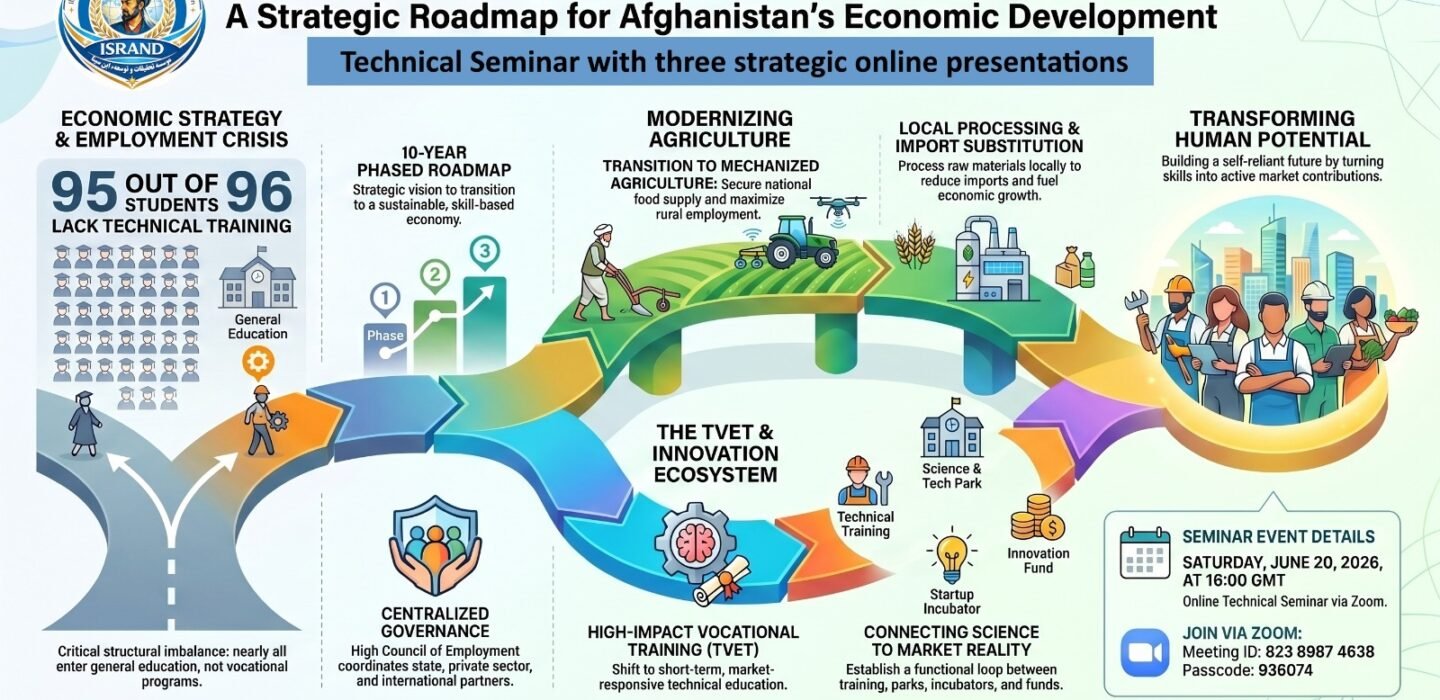
Perhaps the most damning evidence of Afghanistan’s structural misalignment is found in the data from the 1400–1403 (Solar Hijri) period. Currently, the nation operates 18,621 general education schools, yet only 379 vocational and technical institutions (including medical and mechanical institutes) exist to serve the entire country. This has resulted in a staggering imbalance: for every 95 general education graduates, there is only one vocational graduate.
This “diploma-only” culture has led to a surplus of graduates with theoretical knowledge but a total lack of practical, marketable skills. This creates a vacuum where industries such as construction, rail, and technology must import expensive foreign expertise while local graduates remain idle.
As the ISRAND ORG seminar highlighted:
“This gap is a crisis for job creation and must be taken very seriously.”
Analysis reveals that a system prioritizing certificates over competence is a dead end. In a resource-constrained environment, a degree that does not translate into a technical skill is a contribution to economic stagnation, not a solution.
3. Beyond the 2026 Warning: The Three-Phase Survival Plan
To defuse the 2026 fuse, Afghanistan requires a phased, strategic roadmap that moves beyond rhetoric into executive action. The proposed survival plan is broken into three distinct horizons:
- Short-term (0–2 years): The establishment of a “Council of National Skills” to identify immediate market voids. This phase prioritizes “quick-win” technical training in high-demand fields like electrical engineering, rail maintenance, and basic agricultural tech to foster immediate labour market entry.
- Mid-term (3–5 years): A shift toward large-scale infrastructure and industrial parks. By integrating domestic production into these hubs and expanding regional health services, the economy begins to absorb skilled labour at scale.
- Long-term (6–10 years): Transitioning toward a self-reliant, export-oriented economy cantered on import substitution. A critical component of this phase is the “knowledge repatriation” of the Afghan diaspora. After 50 years of civil war, the professionals who migrated represent a vital reservoir of expertise that must be reconnected to the national ecosystem to ensure long-term sustainability.
4. Innovation in the Ruins: The Science & Technology Park Model
A centrepiece of this roadmap is the transition from “Learning to Earning” via Science and Technology Parks. Currently, a profound industrial-academic divide exists; professors and factory owners rarely speak the same language. Academic research remains buried in libraries while factories struggle with solvable technical hurdles.
The Science and Technology Park model acts as a bridge, turning universities into incubators for start-ups and laboratories for industrial problem-solving. This is not a luxury—it is an “Import Substitution” strategy designed to reverse the flow of capital out of the country.
The tragedy of this untapped potential is captured in the seminar’s poignant reflection:
“Afghanistan is so pristine, there are thousands of opportunities under every stone… but we are like someone whose hands are tied while a stream of water passes in front of them.”
5. The “One-Window” Solution: The Farmer Resource Centre (FRC)
Agriculture remains the bedrock of Afghan employment, yet “blind farming”—where producers lack data on soil quality or market prices—stalls progress. The solution is the Farmer Resource Centre (FRC), a localized, “one-window” digital and technical node.
Crucially, the FRC represents a move away from the “donor-dependency trap” of free handouts. Instead, it utilizes a fiscal sustainability model based on cost-recovery. For a fair price, farmers access soil testing, plant disease diagnosis, and market data connectivity. Successful pilots in regions like Mir Bacha Kot (Kabul) prove that when farmers are treated as entrepreneurs rather than aid recipients, productivity and community ownership soar.
6. The “Absolute Advantage” Strategy: Saffron, Rice, and Orchards
The era of “one-size-fits-all” agricultural policy must end. To maximize return on investment, Afghanistan must adopt an “Absolute Advantage” strategy, focusing on regional specialties that are competitive on a global scale:
- The West (Herat): Doubling down on world-class Saffron production.
- The South (Kandahar/Helmand): Focusing on high-value Pomegranate exports.
- The East (Nangarhar/Laghman): Developing the Rice and Paddy sectors.
- The North/Shomali: Utilizing the unique climate for specialized Orchards and industrial crops.
By focusing on what each region does best, the nation creates specialized, stable jobs that can withstand market fluctuations.
7. The Demographic Dividend or a Demographic Disaster?
The stakes for the 2026 roadmap are absolute. With 60% of the population under 27, Afghanistan is either on the verge of an “innovation ecosystem” that fuels rapid growth or a total social collapse. This youth population is a high-stakes asset; if provided with technical skills, they become the engine of a production-based economy. If ignored, they become the catalyst for deep-seated unrest and mass exodus.
8. Conclusion: A Call for a “National Economic Dialogue”
Employment is no longer a secondary policy goal; it must be the core around which all national strategy orbits. The transition from a consumption-based, aid-dependent economy to one of production and skill is the only path to survival.
This requires a “National Economic Dialogue” that transcends slogans and brings the government, the private sector, and the scientific community into a single, unified chain of value.
We must ask ourselves: Can Afghanistan transition from an economy of consumption to an economy of production before the 2026 fuse runs out?
The final takeaway remains unshakeable: “Unemployment is not solved by slogans; it is solved by skills, planning, and cooperation.” The time to build the foundation is now.
For detailed presentations, you can watch our recent technical seminar via our youtube channel: