
Building on Previous Studies to Address Kabul’s Water Needs
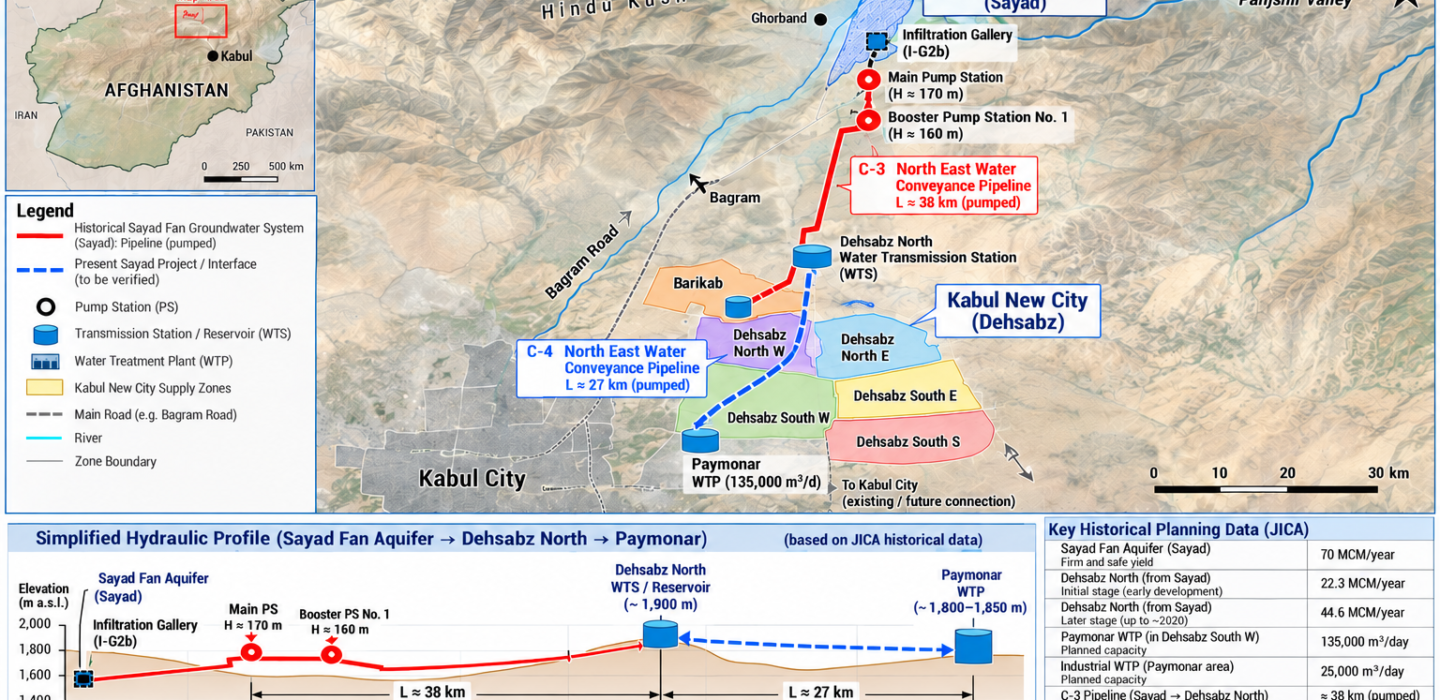
Previous engineering studies have identified the Sayad water source as a potential component of long-term water-supply planning for Kabul. Building on this foundation, ISRAND aims to review historical technical data, assess current conditions, and support evidence-based planning for sustainable water management.
An ISRAND Technical Initiative to Support Kabul and Kabul New City
Reliable and sustainable water supply is one of the most important infrastructure priorities for Kabul and Kabul New City. Growing water demand, pressure on existing groundwater resources, and changing environmental and climatic conditions make careful long-term planning essential.
The Ibn-Sina Research and Development Organization (ISRAND) has prepared a technical proposal recommending that extensive previous engineering studies and investigations concerning the Sayad Water Source (Sayad Fan Aquifer) be systematically recovered, reviewed, and updated where necessary.
The initiative is presented in the technical report “Sayad Water Source – Assessment of Previous JICA–DCDA Technical Studies, Field Investigations and Engineering Documents for Water Supply to Kabul City and Kabul New City”, prepared by Dipl.-Ing. (VDI) G.S. Hassanzadah Shinwari.
The central principle is straightforward:
Make maximum use of existing scientific and engineering work before commissioning additional investigations.
A Strong Foundation of Previous Engineering Work
Between 2009 and 2013, extensive investigations and engineering studies were carried out through cooperation between the Dehsabz City Development Authority (DCDA) and the Japan International Cooperation Agency (JICA), with contributions from Afghan institutions and technical specialists.
These investigations formed part of the wider planning for Kabul New City and the long-term water supply of the Kabul metropolitan area.
The historical work included:
- 31 geophysical measurements to investigate subsurface conditions.
- 5 test wells and 8 test pits for field investigations.
- 16 groundwater monitoring wells for groundwater observations.
- 9 canal-flow measurements.
- A pilot water-collection system, including four documented pumping tests.
- Water-quality investigations, hydrogeological assessments, engineering calculations, preliminary facility designs, and economic studies.
The studies also examined groundwater abstraction, infiltration galleries, pumping facilities, water-transmission pipelines, and related infrastructure.
These investigations represent a valuable body of scientific and engineering knowledge that should be preserved and used in future water-supply planning.
Historical Water-Supply Planning at Sayad
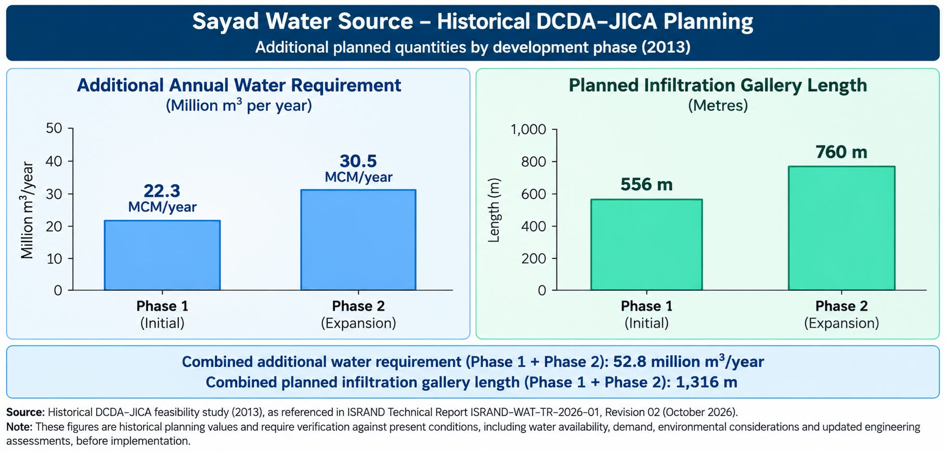
The historical JICA–DCDA feasibility studies examined a phased development concept for water abstraction and supply from the Sayad area.
The 2013 planning documents identified the following additional annual water requirements:

These figures represent historical planning requirements and engineering design quantities, not confirmed present-day water availability or completed infrastructure.
The sustainable abstraction capacity, current water demand, environmental conditions, and applicability of earlier engineering designs must be evaluated before implementation decisions are made.
ISRAND’s Proposed Approach: Retrieve, Review, and Update
Rather than repeating entire studies that have already been undertaken, ISRAND recommends a focused technical approach built around three priorities.
1. Retrieve and Organize the Original Documents
Collect the previous JICA–DCDA master plans, feasibility studies, hydrogeological investigations, field measurements, technical annexes, engineering drawings, pumping calculations, and economic assessments.
These materials should be systematically organized and made available to the relevant specialists at Afghanistan’s Ministry of Energy and Water.
2. Review Historical Findings Against Present Conditions
Carry out a preliminary technical and scientific comparison of the original findings with available information on present conditions.
Particular attention should be given to river flows, groundwater levels and recharge, water quality, climatic conditions, environmental considerations, existing water use, and current water demand.
The objective is to identify significant changes or information gaps, not to repeat the complete historical investigation programme.
3. Update Only What Is Necessary
Where the technical review identifies a specific need, selected investigations, engineering calculations, or economic assessments should be updated.
This may include reviewing capital investment requirements (CAPEX), operating and maintenance costs (OPEX), energy requirements, and the technical suitability of earlier design alternatives.
Such a targeted approach can help reduce unnecessary expenditure and provide a stronger technical basis for future decisions.
Supporting the Ministry of Energy and Water
The present development of the Sayad Water Source is an important opportunity to benefit from the extensive work already undertaken by Afghan and international specialists.
ISRAND’s proposal is intended to support the Ministry of Energy and Water, not replace its technical responsibilities or ongoing activities.
By bringing together historical engineering knowledge and relevant present-day information, the Ministry and its technical teams can better determine which previous findings remain applicable and where additional work is genuinely required.
Preserving Knowledge and Supporting Future Investment
The original studies, engineering drawings, field data, and calculations are valuable technical assets. Their preservation and systematic use can help avoid unnecessary duplication, improve planning efficiency, and support more transparent technical and investment decisions.
The Sayad Water Source Initiative demonstrates how existing engineering knowledge can contribute to Afghanistan’s future infrastructure development.
For Kabul and Kabul New City, the objective is not simply to accelerate planning, but to establish a technically sound, environmentally responsible, and economically appropriate foundation for sustainable water supply.
Technical basis: ISRAND-WAT-TR-2026-01, Revision 02, October 2026
Historical sources: DCDA–JICA technical studies and feasibility reports, 2009–2013.
Prepared for public communication by the Ibn-Sina Research and Development Organization (ISRAND).